 1 hour ago
6
1 hour ago
6
The evolution of European modern art can be explained as a story of susceptible young people falling under others’ spells and then asking, What can I do with this? How can I convert it to my purposes?
What’s remarkable is how often the main chapters of this story have unfolded in coastal or mountain retreats. Think of Claude Monet on the Normandy coast, wrestling with the influence of his mentor Eugène Boudin. Or Henri Matisse staying in Saint-Tropez with his mentor Paul Signac, before breaking with Signac’s neo-impressionist style and co-inventing fauvism. Or Pablo Picasso, goaded into radicalism by the latest bizarre creations of Matisse, retreating to the Spanish mountain village of Gósol and, mere months later, beginning work on his proto-cubist masterpiece, Les Demoiselles d’Avignon. All of these key episodes happened in agreeable resorts, seaside ports, and villages, far from the sophisticated cities assumed to have been the cauldrons of modernism.
Modern art in America is no different. Its story can scarcely be told without reference to artists summering on the Atlantic Coast, including Winslow Homer, Marsden Hartley, and Edward Hopper in Maine and Massachusetts and Jackson Pollock, Lee Krasner, and Willem de Kooning on Long Island.
Beginning in the early 1930s, three Americans—Milton Avery, Mark Rothko, and Adolph Gottlieb—began spending summers together on Cape Ann, along the coast of northeast Massachusetts. They loved the gritty authenticity of Gloucester, the nation’s oldest fishing port. Cape Ann’s distinctive, undulant geography combined pungent industry and village intensity with Atlantic immensity of sea and sky. The story of the relationships among these artists, in particular between the older Avery and the now–stratospherically famous Rothko, shows us American modernism in its moment of greatest transition.
Avery was the mentor figure, the one destined, in the usual telling of this story, to be eclipsed. Whereas Rothko is a regular subject of museum retrospectives in Europe and North America, and his paintings can sell at auction for as much as $98 million, Avery remains relatively unknown outside of the U.S. (The most expensive Avery sold at auction was a little more than $6 million, in 2022.) But are we telling the right story about Avery if we cast him in this role?
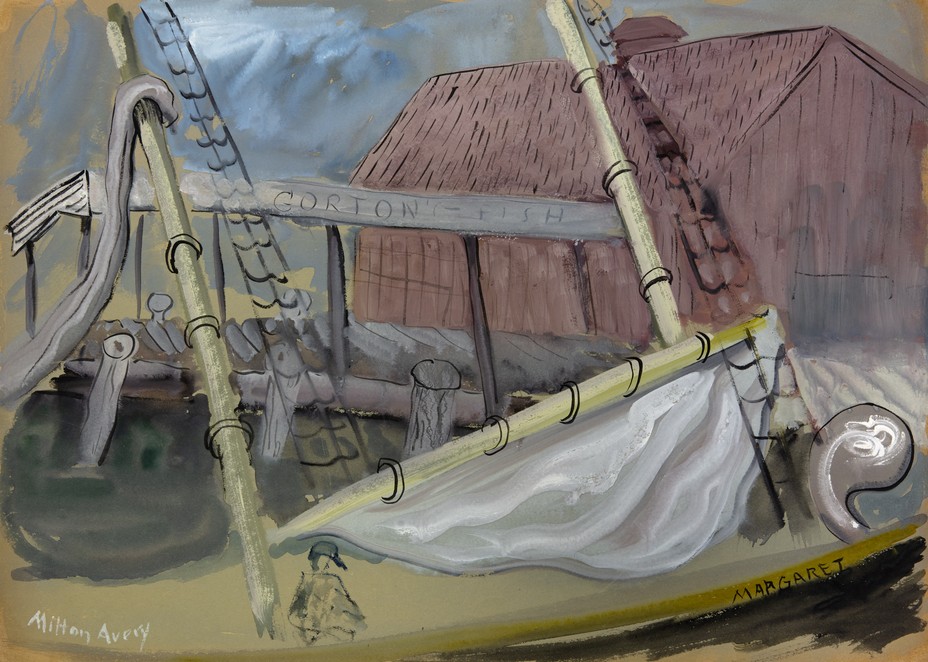 Milton Avery, Gorton’s Dock, 1931–34. Gouache on brown paper. Private collection. Jeremy Lawson Photography. © 2026 The Milton Avery Trust / Artists Rights Society, New York.
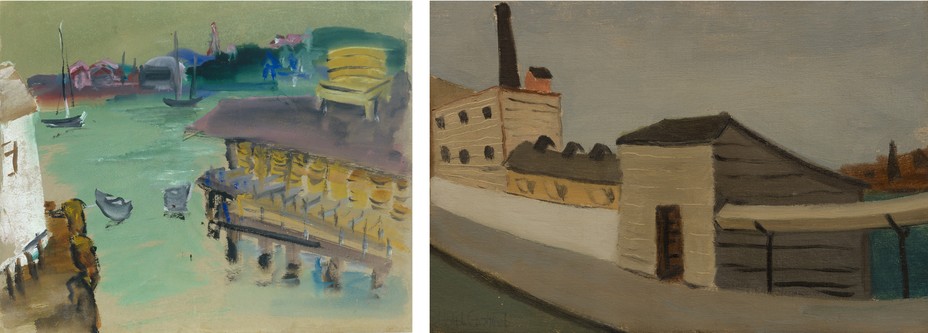 Left: Mark Rothko, Untitled (wharf, Gloucester, Massachusetts), 1934. Watercolor on construction paper. Collection of Christopher Rothko, 1076.25-27. © 1998 Kate Rothko Prizel & Christopher Rothko / Artists Rights Society, New York. Right: Adolph Gottlieb, Gloucester Street, c. 1934. Oil on linen mounted on board. Adolph and Esther Gottlieb Foundation. © 2026 Adolph and Esther Gottlieb Foundation / Licensed by VAGA at Artists Rights Society, New York.
Certainly, when Rothko and Gottlieb, during World War II, turned to abstraction, they broke from Avery and, in short order, became central figures in a mid-century revolution—one that transformed modern art from a marginal activity to a cultural phenomenon attracting cash, prestige, and international acclaim. Avery wasn’t exactly forgotten in all of this, but he has long been overlooked.
He had first come to Gloucester in 1920, returning regularly during the summer until 1945. It’s where he met his wife, a fellow artist named Sally Michel. The fishing port was known as a bustling artists’ colony. In the 19th century, Homer and Fitz Henry Lane had spent productive time there, as had Hopper, Cecilia Beaux, and Stuart Davis in the 20th. So Avery was far from alone as he strolled around the harbor with his sketchbook and retired at night to rudimentary rooms lacking toilets and bathtubs. In 1932, he and Sally, who was pregnant with their only child, were joined on Cape Ann by Rothko—at the time called Markus Rothkowitz; he began using the name Mark Rothko in 1940—and Gottlieb.
Avery was in his element in Gloucester. Confident, good-humored, and in the noontime of life, he sat comfortably on his own shadow. Unlike his protégés, he was not especially intellectual. He was a taciturn pragmatist with a gentle sense of humor. He had a dog called Picasso. To those who said modern art was ugly and hard to appreciate, he would answer: “Olives taste ugly, too, until you learn to enjoy them.”
Read: Did Marcel Duchamp ruin art?
The two younger men felt his support, but he didn’t force his ideas on them. According to Eliza Rathbone, the curator of an exhibit about the trio’s seaside summers currently on view at the Cape Ann Museum, Avery “never uttered a word of advice or instruction to any painter other than ‘do another one.’” He set an example: how to be a modern artist, yes. But also: how to be a husband and father, how to carry on. His very reticence was liberating.
The three men had become friends in New York, where they would gather in the evenings to sketch and discuss art at the Averys’ Lincoln Square apartment. “I cannot tell you what it meant for us during those early years to be made welcome in those memorable studios,” Rothko would later recall.
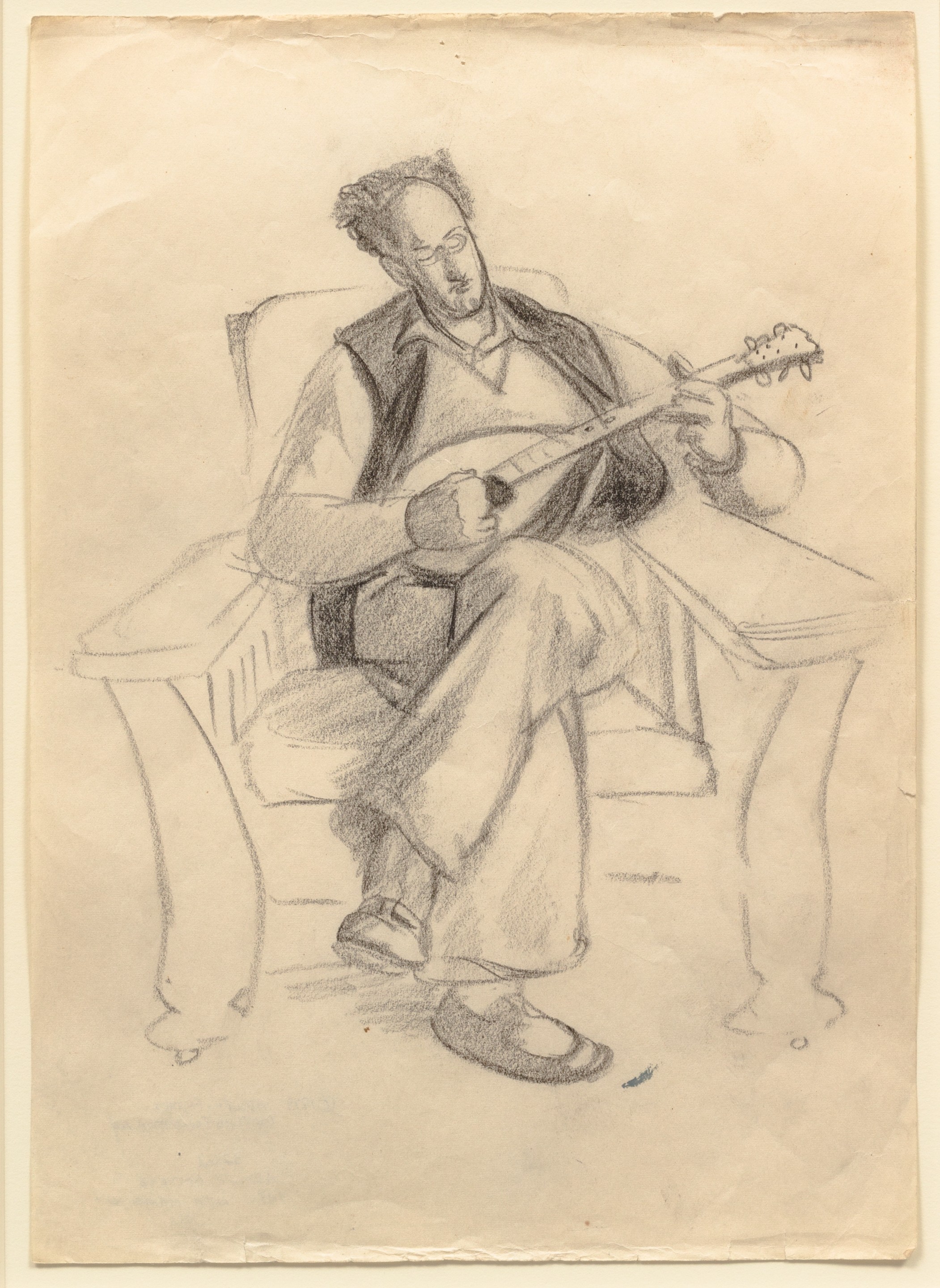 Adolph Gottlieb, Untitled (Mark Rothko with Mandolin), c. 1932. Crayon on paper. Adolph and Esther Gottlieb Foundation. © 2026 Adolph and Esther Gottlieb Foundation / Licensed by VAGA at Artists Rights Society, New York.
In Gloucester, they explored the port, with its wharves and warehouses and fish-processing facilities, filling sketchbooks and painting small-scale works in watercolor. A total solar eclipse that August provided fodder for Avery, who made an amusing watercolor showing people on Good Harbor Beach looking at the celestial phenomenon through smoked glasses and colored film.
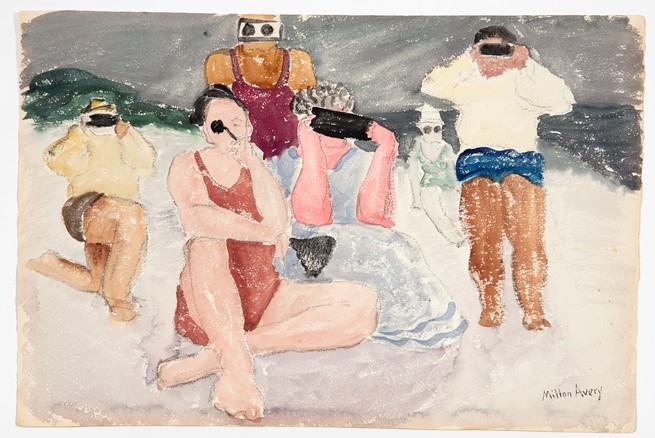 Milton Avery, Eclipse Watchers, c. 1932. Watercolor on paper. Private collection. Jeremy Lawson Photography. © 2026 The Milton Avery Trust / Artists Rights Society, New York.
That first summer together was bookended by major life events back in New York. The Depression had flooded the streets with the unemployed. Gottlieb married in June. In October, as memories of summer receded, Sally gave birth to a daughter, and a few weeks later, Rothko married.
In those days, Rothko and Gottlieb would study Avery’s paintings and, according to Sally Avery, “take them apart.” On Cape Ann, they watched him treat the beach as a backdrop against which he placed monumental, thick-hipped figures, arranging areas of pattern (umbrellas, beachwear) against flat, colored shapes in compositions with shifting horizon lines. Following Avery’s example, they experimented with gouache and watercolor applied to colored construction paper.
The Averys and Gottliebs returned in the summer of 1933, and were joined by the Rothkos in 1934. The Depression was biting hard, but the artists’ life in Gloucester remained simple and uncorrupted. “We saw each other day in and day out,” Sally recalled of those years. “Evenings we’d gather to have a cup of tea and look at our day’s work. There was no talk of selling—only of painting.”
“I always thought Avery was a great artist,” Gottlieb would later say. “I always regarded him as a brilliant colorist and draftsman, a solitary figure working against the stream.” Gottlieb was right. Avery was one of the 20th century’s most original colorists. His expansive compositions were influenced by Pierre Bonnard and Matisse as well as by American folk art. Unlike Matisse, who loved bold, blatant colors, he favored unusual, in-between hues—mauves, browns, pale greens—all close in tonal value. He would often unify three or four slightly clashing varieties of the same color with a complementary hue elsewhere in the arrangement. Like spacious minor-key chords given a subtle major-key lift, these color combinations can arouse powerful emotions that are excruciatingly just short of fulfillment.
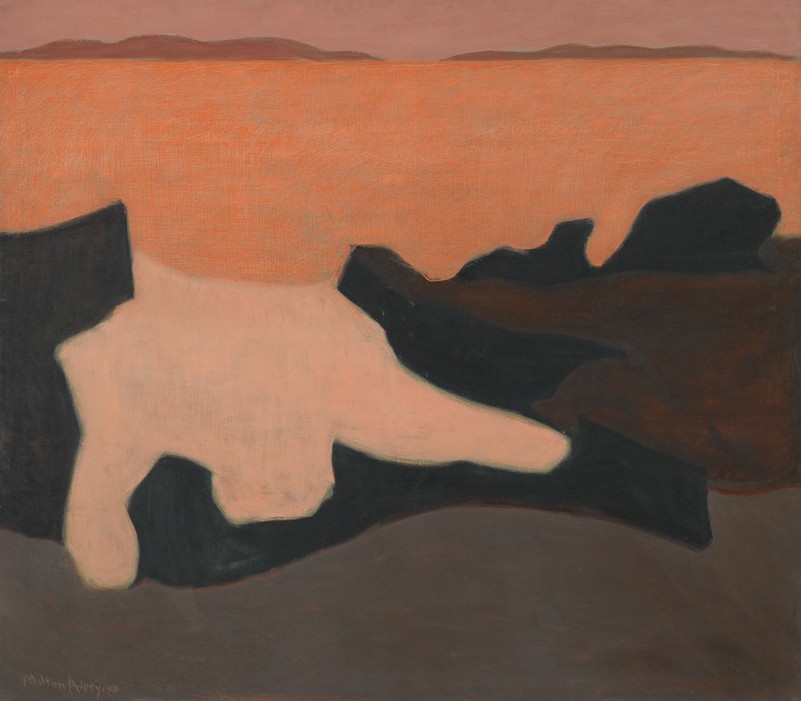 Milton Avery, Sunset, 1952. Oil on canvas. Brooklyn Museum of Art, New York. Gift of Roy R. & Marie S. Neuberger Foundation, Inc., 58.40. © 2026 The Milton Avery Trust / Artists Rights Society, New York.
When it came to being influenced by others, Matisse understood what was at stake. But, he said, “I have never avoided the influence of others. I would have considered it cowardice and a lack of sincerity toward myself.”
To be open to influence is to risk being dislodged from your former self. It requires you to have the confidence to convert the ensuing upheaval to your own (still unknown) purposes. The process is complicated and rarely goes smoothly. Often, though not always, it involves some kind of betrayal.
No one betrays anyone in this story. All three artists remained friends. But the two younger painters, Rothko and Gottlieb, although deeply affected by Avery’s original way of painting, eventually decided that they needed to go further—to change not just the colors, the shapes, or the subjects, but something more fundamental.
In 1943, they broke away. Perhaps coincidentally, perhaps not, the breach happened just as Avery was beginning to thrive. He had been choosing larger canvases and distilling his paintings down to a few essential ingredients. The strategy was working. His work was selling. Dealers were fighting to represent him. He had a series of successful shows. The reviews were good.
Rothko, meanwhile, experienced a creative crisis and, in 1940, stopped painting for a year. He had been digging into philosophy, reading Schopenhauer, Nietzsche, and Kierkegaard, as well as the Greek myths and tragedies. Gottlieb, at the same time, made works merging surrealism with imagery inspired by masks and ritual objects from Africa, the Pacific, and Native North American cultures.
As the two younger men moved steadily closer to total abstraction, a tension that has in many ways defined American art—between the concreteness of the material world and the amorphousness of the sublime—was coming to a head. Avery, ever loyal to his sketchbook, remained committed to direct observation of particular people and places. His summer companions were about to throw in their lot with the sublime.
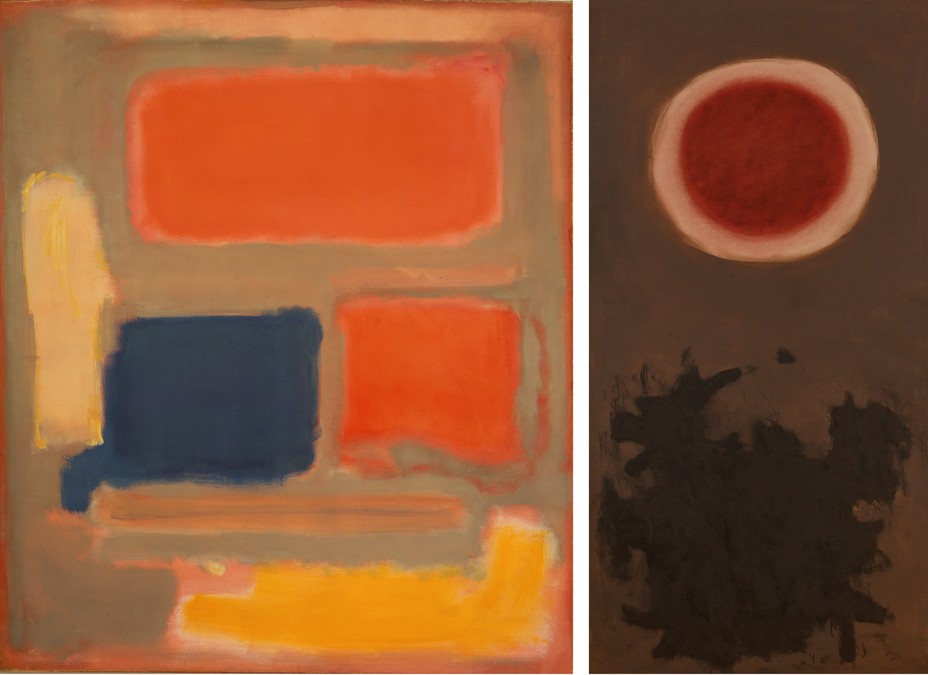 Left: Mark Rothko, No. 20, 1949. Oil on canvas. Collection of Christopher Rothko, 5096.49. © 1998 Kate Rothko Prizel & Christopher Rothko / Artists Rights Society, New York. Right: Adolph Gottlieb, Under and Over, 1959. Oil on canvas. Wadsworth Atheneum Museum of Art, Hartford, Connecticut, 1961.5. Photograph: Allen Phillips / Wadsworth Atheneum. © 2026 Adolph and Esther Gottlieb Foundation / Licensed by VAGA at Artists Rights Society, New York.
The push toward abstraction in mid-century American art coincided with a surge of interest in existentialism, which had begun to displace the pragmatism that underlay Avery’s approach. A sense that even the closest ties might be loosened by what T. S. Eliot—who had himself summered for nearly two decades in Gloucester—had described (in a review of James Joyce’s Ulysses) as an “immense panorama of futility and anarchy” was lent gravity by the world wars. But the human predicament, as Albert Camus made clear in The Stranger (1942), went beyond man-made conflict. It was inextricable from all that was inhuman, arbitrary, and immense—from the blinding energy of the sun on an Algerian beach, for instance.
On Cape Ann, Rothko and Gottlieb thought a lot about the sun, as well as the sea, the sky, and the smallness of human life. They were no doubt aware of the death-haunted history of Gloucester, where, between 1866 and 1890, more than 2,450 Gloucester men and 380 schooners failed to return from the fishing grounds. They wanted their art to communicate awe, and a sense of the insecurity and brutality of existence. It was as if the Atlantic were pulling them out to sea, away from both the harbor intimacy of Gloucester and the embrace of Milton and Sally Avery.
In 1943, Rothko and Gottlieb co-authored a letter and sent it to The New York Times, which published it on June 13. The letter responded to the Times critic Edward Alden Jewell, who, in a review, had misjudged (they felt) paintings by Rothko and Gottlieb. It also doubled as a five-point manifesto: “To us,” they wrote, “art is an adventure into an unknown world, which can be explored only by those willing to take risks.” That was the first point. The fourth point ended: “We are for flat forms because they destroy illusion and reveal truth.” According to the fifth point, “only that subject matter is valid which is tragic and timeless.” A concluding salvo declared that for their work to succeed, “it must insult anyone who is spiritually attuned to interior decoration; pictures of the home; pictures for over the mantle; pictures of the American scene”—the list continues—“prize-winning potboilers; the National Academy; the Whitney Academy,” and so on.
Read: What are Frederic Church’s stunning landscapes trying to tell us?
Avery could easily have felt personally targeted. He had exhibited, after all, at the first and second Whitney Biennials (in 1933 and 1936); he painted domestic interiors and American landscapes; and his pictures could be called “decorative” (at least in the sense Matisse meant when he described his more ambitious paintings as “decorations”).
He was probably too magnanimous—or phlegmatic—to take umbrage, and the summer proceeded pleasantly enough. If the group dynamic had become awkward, it correlated, the art historian Robert Hobbs wrote in his monograph of Avery, “with the way rebellions between initiates and their mentors are frequently enacted: certain brash rejections are cushioned with compliments, and personal assurances attempt to heal the break that has in actual fact been made.”
Which it had. Mentor and protégés went separate ways. They wouldn’t summer together again until 1957, when they reconvened in Provincetown on Cape Cod.
Sometimes after a clear-cut break, a reciprocity gradually reemerges. Even as the abstract expressionists transformed American art, Avery wasn’t entirely left behind. The period’s most influential critic, Clement Greenberg, cast Avery as a sort of John the Baptist to the artists whom Greenberg had tried to deify. The new crop of abstract painters, he wrote in 1957, “has certain salutary lessons to learn” from Avery “that they cannot learn from any other artist on the scene.”
In World War II’s immediate aftermath, Rothko painted abstract, colored shapes, beginning with what he called “multiforms” and shifting, around 1949, to his signature format of floating “lozenges” of soft-edged colors. He liked to layer warm and cool colors, so that in one lozenge a cooler purple might subdue a thin overlay of red while in its neighbor, a warm yellow rises like steam through the same red. The effect can be akin to music, and so intensely affecting that you’re almost willing to accept the artist’s preposterous rhetoric about his work. (“I would like to say to those who think of my pictures as serene,” Rothko once wrote, “that I have imprisoned the most utter violence in every inch of their surface.”)
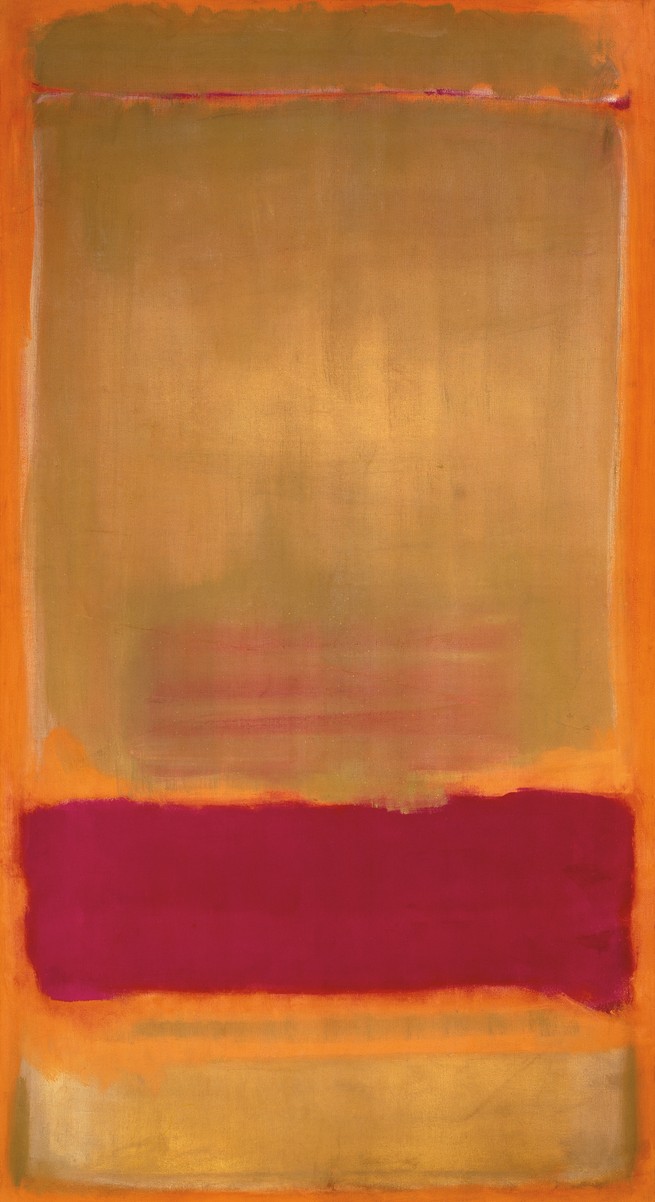 Mark Rothko, Untitled, 1949. Oil on canvas. Collection of Kate Rothko Prizel, 5158.49. © 1998 Kate Rothko Prizel & Christopher Rothko / Artists Rights Society, New York.
Meanwhile, Avery, working now on larger canvases, let particulars of the observed world dissolve into trembling fields of color. The paintings remained recognizable depictions of sea, land, and sky, but they, too, had as their true subject something closer to music. A gallery in the Cape Ann Museum exhibit (which will travel to the Phillips Collection, in Washington, D.C., in October) allows these late Avery paintings to share space with a sequence of mature Rothkos and similarly spare Gottliebs. The sense the gallery creates is of all three artists tenderly reunited and singing together in unison.
If Rothko’s abstract paintings recall the ethereal, spatially ambiguous atmosphere of Caspar David Friedrich’s Monk by the Sea (painted between 1808 and 1810) or certain late works by J. M. W. Turner, they may also evoke the natural environment he observed on Cape Ann. His compositions are oriented vertically, but the lozenges nestled within each painting tend to be horizontal, so it’s tempting to see the thin strips dividing them as swaths of land hovering between sea and sky. Gottlieb, too, favored shapes that suggested the sun and moon—phenomena that he, a passionate sailor, had daily observed while out on the water.
Despite all of this concordance, I came away sensing something unresolved about the relationship among these three powerful artists. The late Averys are good, but they’re simply not as strong as the best Rothkos, which hum with colors so richly resonant that they make Avery’s attempts to work on a larger scale look anemic. The Averys also lack the deep, metaphysical suggestiveness of the Gottliebs.
Yet when you set aside the late works and consider Avery’s oeuvre, it seems to me that he was the better—more richly poetic, more generative—artist. The problem with the abstract expressionists’ relentless courting of the sublime was that the process of distillation produced too much bombast. And it led them into a cul-de-sac. As a skeptical character in John Updike’s novel Seek My Face put it, referring to the postwar generation of abstract expressionists, “they all still spoke of painting in terms of self-exploration and an agonized authenticity that would revolutionize the world and whatnot, but the results were a little like company logos, everybody working on the scale of 19th-century academic art but each of them having come up with some eye-catching simplification.”
After Rothko settled on his signature manner, the level of repetition in his work became oppressive. Gottlieb, too, as he chased the sublime, seemed to shun the finer tendrils of the sensuous world, with results that felt fatally monotonous.
To Greenberg, Avery was a prophet, his work a precursor to his younger peers’ more radical experiments. But maybe Avery was actually better than that. Rejecting Greenberg doesn’t mean claiming that abstraction was some kind of aesthetic mistake. But I would argue that, whereas Avery’s paintings continued to be aerated by the beautiful unruliness of the material world, Rothko and Gottlieb, especially later on, were relatively formulaic.
True, if forced to choose, I might prefer to look at my favorite single Rothko over my favorite single Avery. But I would rather spend time with a dozen of Avery’s finest works than a dozen of Rothko’s. That’s because Avery understood that a deep canyon separates things in the world from their representations in art. The mystery of painting lies in what takes place in that shadowy, fertile zone, where what you thought was green foliage turns into the strangest dark purple, that body of gray water has flushed vivid turquoise, the blue sky is now flaming orange, and you don’t even know whether these transformations have taken place in life or on the canvas.
Avery proved that figurative artists, in trying to represent the observable world, can be as free in their choices as any abstract painter. But their work is less likely to become clichéd, because any stale fixations will always be rinsed and refreshed by the real.